Sunday, February 3, 2013

PLAYLAND


For decades "Playland at the Beach" was a major feature attached to the Pacific (west) edge of San Francisco's Golden Gate Park.  Locals called it "The Concessions."  I grew up during its midlife -- its hey day.  Playland began its gentle drift into oblivion, a descent triggered by the Great Depression, the movie industry, and the automobile.  At 17 cents a gallon, driving south on the Peninsula, or north through Marin County, or east to Moraga had more allure than the chill winds of the sea.  I recall that, in school, our latitudes were designated “the prevailing westerlies.”  Since our teacher did not define “prevailing” for us, I thought it meant “incessant.”  I was right, and they were always cold.

The two great bridges made Playland's corny carnie even duller. As competition increased,  Playland's management quit bothering to keep the grounds clean enough. However, a concession manager lived next door to us and peeled off free passes like confetti.  So I went with friends fairly often across the Park to the pike.  Free was free.

The tickets didn't pay for hot dogs, cotton candy, chocolate bars, and other stuff that teenagers gobble up, of course.  Perhaps my neighbor's generosity was not without wisdom.  And high school kids have friends.

One time, Alex, his girl friend, her friend, and I decided to roller skate from Market and Powell Streets past North Beach, west by Fisherman's Wharf, to Sutro Heights, on  to the Seal Rocks, and  to Playland for food.  It wasn't as daunting as it may sound, as San Francisco isn't very big.  But Alex's mother did say, "You're nuts." Alex's mother was a savvy woman.

We checked our skates, shoes, and wore comfortable clothing.  We were nuts, but not totally stupid.
                
As we left Alex's for a downtown trolley, his mother said again, "You're nuts."  My mother would have said the same, if we'd left from my house.  The girls' mothers, too.

One of the few flat places in San Francisco is the cable car turn table at Market and Powell where we began our little excursion.  No wonder the city's street cars go through tunnels.  We were about to get plenty of exercise.

Chinatown
The start was uneventful.  We worked through China Town, Little Italy, Girardelli Square, and, after a malt shop pause on Clement Street, we reached Sutro Heights promontory, the start of a slalom decent past the Seal Rocks and San Francisco's famous Cliff House.

Cliff House with Seal Rocks
We had agreed to pause at "The Rocks" and watch the surf there smash upward several stories, slopping sea water into the natural basins that, in turn, drained into the five swimming pools inside the Baths.  We had agreed to start down the steep grade but pause halfway by the Cliff House.

The slope began gently enough.  Alex and Shirley coasted very slowly; but my partner seemed unable to check her speed. All I could do was catch up.

We shot past the Cliff House entrance as people standing there gaped.  I concentrated on keeping my partner upright. At least there was a long, level pedestrian pavement at the base of the curve, a half mile parallel to the beach.  We could probably coast to Playland.

I yelled through the whistling wind.  She nodded and smiled.  Our survival appeared hopeful.  Well, except for the broad grating at the base.  We'd have to clear it.

Again, my partner nodded.  Her fingers squeezed my arm HARD. “JUMP!” I yelled.  Her grip hurt. We left the pavement together. Amazingly, we came down on the skates with a modicum of grace, and coasted on...into a sand drift.

How I got my feet out in front I don't know.  They just  were.  Still squeezing the blood out of my arm, most of her was almost level, like a racing dive.  I grabbed at her  jacket.  And it held.  It held, and as we slowed, she began to straighten up.  At last we stood facing each other, and she began to laugh.

“Do it again?” she giggled.

“Not until Sutro's is levelled,” I responded.

Alec's girl friend checked us both over.  “Mom told us we were nuts,” he said.

My partner said, “We're not telling your mother... nobody.  I may never marry.  I might be tempted to tell my grandchildren.  If I don't have any, they won't know.”

Actually, I may have to do that downhill run again.  The Sutro Baths are gone.

Sunday, January 20, 2013

Archery


Regardless of one's college major, most states require every undergraduate to enroll in physical education courses.  In state universities, these are legislative regulations, no exceptions.  Actually, only P.E. instructors cared; but, you know: the law is the law. Why else have lawmakers? Administrators didn't care.  They just wanted forms filled in.

As the rules didn't say anything about what a P.E. class had to be to pass muster, at Cal State San Francisco, John Haake and I signed up for girls' archery.

We didn't have to change, or shower, or sprint to the next class in the few minutes remaining. And if it rained, we didn't even have to leave the library.

The targets were set up at the football field, a comfortable walk from the main campus building. Neither of us was particularly skilled.  Big deal!  Neither were any of the girls.  And nobody cared, not even the instructor.  She told us she was grading us on showing up and on helping each other. BUT we had to retrieve our own arrows.

The best part about the practices was that between every volley of arrowing,   we all sauntered to the targets and back together. Girls do talk a lot.

After a while, we were actually hitting the targets oftener than not.  One girl made a bulls eye once. She had the instructor sign the target. She took it to her sorority.

I hadn't planned it, but all through high school and college, I only went to a regular P.E. class a total of three semesters -- in tenth grade, once Cal. State San Jose, and once at Cal State S.F.
       
At Berkeley they let you play noontime basketball.  Several fellows made themselves a team (of sorts) that would do. At San Jose they insisted that, if you were going to teach, you had to play on a squad of some sort three times a week.  One semester of that qualified for P.E. credits.

I wasn't cheating my body, and, clearly, nobody cared.  My sister, who followed me to S.F., asked me if the archery girls had to wear “those awful gym outfits.”  When I said no, she said she would sign up for the next semester.  I don't remember if she did or not. Probably not, because she began dating a basketball player. The basketball court was nowhere near the football field.

Sunday, January 13, 2013

Sully


His surname was “Sullivan," which, of course, meant that he was called “Sully.” He made basketball look effortless.  He was always in the right place doing the right thing with graceful ease.  I wished he’d been playing for our Polytechnic High School.  When his team from Lowell High came to our gym to play our 135 pound squad, I was assigned to write up our game for our school paper, but I focused on “Sully” from the time his team got off the team bus.

High school students collect in fairly good numbers to watch football contests, but the rooting sections for nearly any other activity rarely reaches double digits. This game between Sully’s Lowell High "lightweight" squad and our very ordinary squad drew about a dozen spectators, probably all relatives of the players with a girlfriend or two.


Sullivan had come to play basketball just the same, and he was magnificent.  He made our players look as if they hadn't been coached much.  My “Poly” was embarrassed.

When I turned in my report to our faculty advisor, she said,  “You’ll be criticized for putting this in our paper.”  I shrugged.  “He's better than anybody in our whole school,” I said.  “He's the best in the league at any weight.”
              
“All right,” she said. “You’ll hear about it, though.”  I gave another elaborate shrug.  The flack wasn't as much as she’d predicted, and only my friends actually called me dumb. 

Lowell’s school paper reprinted my story.  Then the San Francisco Chronicle apparently took notice, giving Sully a half page following Lowell's reprint.


When Sullivan became the first “lightweight” basketball player in a San Francisco high school to be named “All City” on the unlimited team, I sort of felt that I’d contributed.  Anyway, I felt justified in writing up an "enemy" athlete.  Also, my faculty advisor suggested that I had earned a parenthesis alongside Sully's name. 


I never saw Sully after that game or heard what happened to him, except that a Sullivan from Lowell was listed as a WWII casualty.  I am glad I was assigned to cover that game.  It was like watching a leopard.  It also taught me that I wasn't one.

Sunday, January 6, 2013

Guerillas


While serving in the Pacific, most of my orders for my LCT (Landing Craft, Tank) were simply a TBF message to proceed to a coded point in the Leyte Gulf, and then to another. These meant a ship was waiting for us, where we would take on a cargo and later beach it at a coded location.  We didn't believe that our progress was much of a secret, as we were quite sure that Japanese hiding in the hills were watching our every move. They couldn't know our cargoes exactly; but if they were as smart as we (and they were), nobody was fooling anybody.  It just didn't matter.

Sometimes, though, we actually did something secret.  Like the time our cargo was a group of eight Philippine guerrillas and their officer.

Arriving at a beach well south of our usual haunts, we were met by the Philippine officer (a man in his late twenties) and his crew of eight, all of them under twenty, which become our secret cargo.  The officer was a handsome, clean cut, articulate person.  The eight who boarded with him were something else. They could have arrived the day before from East Los Angeles.

The nine young men came over our ramp like cats over a fence.  They were lithe as gymnasts, smoothly muscled, their eyes flicking this way and that like Mafiosos on a job.  The officer approached, saluted, extended his hand, identified himself, and never smiled.

I returned his salute, and shook his hand.  The salute part was awkward, as no LCTers bothered with any protocol, nor among officers, and, on my ship, between my crew and me.

I offered him and his men coffee, a shower, and whatever else we might do for them.

He spoke beautiful English when he thanked us for our hospitality.  His crew accepted the coffee but were disinclined to converse much with my crew. None of them spoke much English and little more Spanish. Their fluency was in Tagalog. It might as well have been Navajo.

Ignoring the nearly vertical sun, they sat on the deck in a tight ring.  At least one, usually two, constantly swept eyes over the area. Every time a door moved the slightest bit, an extra wave tapped our vessel, or a new sound from beyond the ship occurred, all eight heads flipped.
The officer, a lieutenant, told me that he had four years of engineering at Manila's university and hoped, “after this,” to do graduate work at the University of Southern California.

“Your crew?” I asked.

His face clouded.  “They only know to murder,” he said too softly for any of them to hear. “They'll go back to their villages; but they won't adjust well.  They'll drift to Manila, or another city, and do what they've been doing now since Bataan -- murder.  They're restless now because we've only gotten about a Jap a day for the past week.  We know that there are a few thousand in those hills.” He pointed north.

I smiled. We'd been sailing by those hills several times a day for weeks, usually close enough to see parrots.  We'd even considered inspecting a waterfall we could see back a short distance in the hillside.

“USC,” I said. “It has a fine engineering department.  Lots of the students are Arab.”  The officer nodded.  “And, at USC, about 25 per cent of the students will be Nisei and Sansei.”

The officer pointed to his eight young men.  Very softly, he said, “They don't know anything else.  They couldn't live there.”

“You?” I asked.

He didn't answer.


El Valle de Los Caidos


While Nazi Germany plotted the Berlin-to-Baghdad Express, Stalin thought that competition meant eliminating everybody.  Europe and the U.S. pretended that if we just looked the other way, they would go away.  They didn't.

Instead, the world wide disaster brought on by the Roaring Twenties and the Allies having trashed WWI's losers, led to the mushrooming of dictators, every country seeing enemies among themselves.  Up sprang opportunists promising instant relief.  Translation: “I'll rescue you from these enemies within.  And I'll beat up on your neighbors.”  They all called themselves Socialists.  It was the first time I'd heard of right wing, conservative socialism; but then Stalin's Communism looked remarkably like Ivan's Czarism.

Francisco Franco was “protector of the Crown,” building his Fascist army in Africa and bent on turning Spain into his own Falange.  Hitler, wanting to try out new weaponry, gave to Franco guns, specialists, and military vehicles. Stalin promptly matched the Nazi contributions with his own. Spain's modest, internal tussle stopped being modest.

England only really cared about Gibraltar and remained technically neutral. Which, de facto, meant Spain was flooded with enough spies to form an unofficial United Nations.  Spain became the safest place to be during WWII.

That, in turn, meant Franco had to keep his people relatively calm. Unlike every other dictatorship, he treated loyalists and populists alike with careful respect. 

Toledo
His political masterpiece was creating El Valle de los Caidos (The Valley of the Fallen), memorializing combatants of BOTH sides equally. Placed in La Mancha, not far from Toledo, the site is deliberately isolated.  Even the countryside is quiet, almost barren.  Rising from the cone of an ancient caldera, Franco built a magnificent basilica replete with massive, action murals.  One could be standing before Diego Rivera exhibitions.

Driving toward the site, one begins to feel a grayness settling in. The memorial spire appears gradually, peering above cone center.  Finally, coming around a curve to the parking area, the great building emerges suddenly, like a curtain drawn. 

A wide promenade surrounds the basilica guarded by several bronze lions, larger than elephants.


Inside, the dome is dominated by massed action murals, massed violence.  Bloody courage is everywhere...above, to the sides, in every direction, even in side rooms.  Inscriptions detail the history minutely. 
              
A guard helped me photograph one of the side room ceiling murals.  I asked him how Spaniards, some three decades since the war, now feel about Franco.  He shrugged slightly.  He responded in Spanish, “That was then. El Generalissimo has mellowed, as have we    my parents. We Spanish are, as you say, open of the heart.”

He was so right!  I loved Spain.  Probably because they were so wonderful to me, everywhere.  The longer I was in Spain, the more I've puzzled that these people could have waged the most savage violence on each other.  

Sunday, December 30, 2012

Damascene


Castles on the Rhine aren't there accidentally. The Rhine is a big river, and ever since boats were invented, this river has been Europe's most valuable means of commerce.  For millennial bends in the river provided ideal spots for bullies to build castles overlooking bends and tributaries to extract fees from merchants needing to go upstream and down.

Toledo was born with that idea in mind; but Spanish rivers are fewer and don't command much commerce.  Still, Toledo is imposing, looming over the plain to the north like a sentinel.  A military couldn't do much about Spain without controlling this city built on a huge rock.  It has the fewest level streets of any European city.

I didn't have an urge to dominate the Castile region, but I did want to spend  time in a city that has a cathedral that resolved its unfinished dome problem by having angels flying around the hole.  I wanted also to see El Greco's home. He couldn't marry the love of his life because, since she was a Jew, if he married her, his son would be ostracized. (You figure that one out).

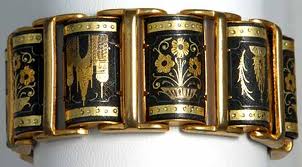
Actually, I went to Toledo because I'd been told that it is the number one place in the world to see how Damascene is made. The number one shop is just north of the monster rock that is the city.

Damascene refers to Damascus, the probable city of the technique's origin.  The decorated steel figures appeared when Turkey, Syria, and the Caliphs of the Tigris/Euphrates were beating up on everyone in general and had established a lock on southern Spain. The world's best steel then was Persian made. The Caliphates tossed in stuff like Algebra, medicine, cotton, and were pretty good at building palaces and mosques. They became incredibly good at decorating things, including armor and plaster. Decorating their horse trappings and armor with delicate designs of gold on steel was the ultimate in their art.

When Isabella and Fernando rooted out the last of the Moors (who were mostly north African), some Spaniards had mastered this mostly secret art of welding steel to gold.

If it had been the high season, I might have been out of luck to learn much; but as soon as I showed interest in the torches, the supervisor of the shop I examined gave me a tour that lasted all afternoon. The lead welder   explained why the torches were of varying sizes, how they fused the steel and gold, and how the black is applied. I was allowed to meander everywhere, which was about the size of two tennis courts.  As you might expect, not the tiniest amount of gold ever hit the floor, or disappeared.  A little steel might be burned away, but very little of that either.
       
Once I commented on an interesting steel design high on a wall. The foreman instantly went ballistic.  "EL CID!!!" he yelled.

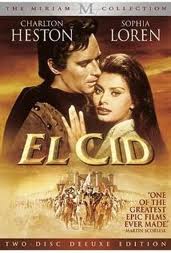
When he eventually cooled off enough to speak at a pace I could track, he led me to understand that a movie company (American) had produced the film "El Cid" on location near Toledo and contracted for all sorts of welding and weaponry and other props useful in the film. But they had not been very forthcoming with cash when due.

"Hollywood!" my tutor finally grumbled, drawing a finger across his throat.  When he eventually stopped sputtering, he murmured something that was probably just as well I couldn't translate.

At last he smiled. He pointed toward a large sign outside the shop that told visitors there was a forty percent discount on Damascene that day.

“For the buses,” he said. “Means nothing." Then he added, "Don't buy when the buses are here. When there is just you, then buy. Not forty percent... Eighty percent.”

I still have the bolo I'd watched him make from a blob of gold and a piece of steel.  AND I got it at eighty per cent off some price he invented because "the bus people" were not shopping.

Sunday, December 23, 2012

La Sagrada

Barcelona has an admixture of citizens who think the rest of Spain is a pain, who aren't sure if they want to be Spanish, who love being Catalan, and who kind of like the idea of independence. They're certainly thinking about it. But I hope they don't. That would take some of the gloss off La Sagrada
The Basilica of the Holy Family is unique, not only to Spain, but to the entire world and through history. I've seen the Eiffel Tower, the Winchester House, St. Basil's in Moscow, Watt's Towers, Neuschwanstein Castle, and the Hearst Castle. None so totally boggles the mind as La Sagrada. “It's probably impossible to find a church building anything like it in the entire history of art.” (Reiner Zerbost)


Ground breaking was in 1882. When I saw it, construction had gone on for a mere ninety years, which doesn't mean that Spaniards, not just Catalans, don't love it dearly. They do. Possibly the strongest sentiment tying northern Spain to its south is this basilica dreamed up by their Catalan, Gaudi.


When I arrived at the site, it was good that I had read Michener's “Iberia,” or I'd have assumed that it was another relic of a WWII bombing. Ninety years had produced several massive gray walls soaring grimily toward the stratosphere, each interrupted occasionally by slits that might someday be windows. 

At street level among them were what seemed to be randomly distributed clutters of building blocks, saw horses, enough tarps to cover a football field, wire, hoses, and several power grinders ravaging the ears. The deck was barely discernible, as the flow of Mediterranean air stirred up the mass of powdered concrete. My impulse was to return at once to Las Ramblas, the wonderful “Street of Flowers,” which bubbled with color and happy faces.

Construction began in 1882. Completion is anticipated  in 2026, 100 years after Gaudi's death.

But I had come here to see “Gaudi's Cross.” Topping this massive basilica was the “Christmas Cross.” I had to see it.


When a laborer looked up at me and smiled, I promptly asked him how I might get to “the Cross.” He pointed to an opening at a tower base and pointed up.  So I began to climb...


…up.  And up.  And up

I'd hoped that the winding staircase would become somewhat less gritty by the first hundred feet. Instead, I learned that the Mediterranean breeze blew up as well as north. The only sensible thing was to hope for a bath some time later and to protect my camera no matter what.

Then, about the time I was wondering if I'd be getting the bends, I passed another window slot, and there it was: red and green and decorated, just as they had said.


I guess I'd expected something more or less Medieval; this looked more as if a children's Sunday school class had done a Christmas project.

Disappointed, though, I was not. It was just astonishingly different. And I had my camera and a close-up. My clothes were filthy. Even my teeth were gritty. But so what?

Someday, in 2082, perhaps, La Sagrada will be all shiny and filled with Catholics, and Gaudi can look down and say, “C’est mon.” But NO!!!  He wouldn't dare speak French, not even Basque. In every part of Spain, La Sagrada is personal, the same way “The Falls” and “The Arch” are here.